> For the complete documentation index, see [llms.txt](https://usecaseframework.openactive.io/llms.txt). Markdown versions of documentation pages are available by appending `.md` to page URLs; this page is available as [Markdown](https://usecaseframework.openactive.io/appendix-one-engagement-protocol/interaction-process-map.md).

# Interaction process map

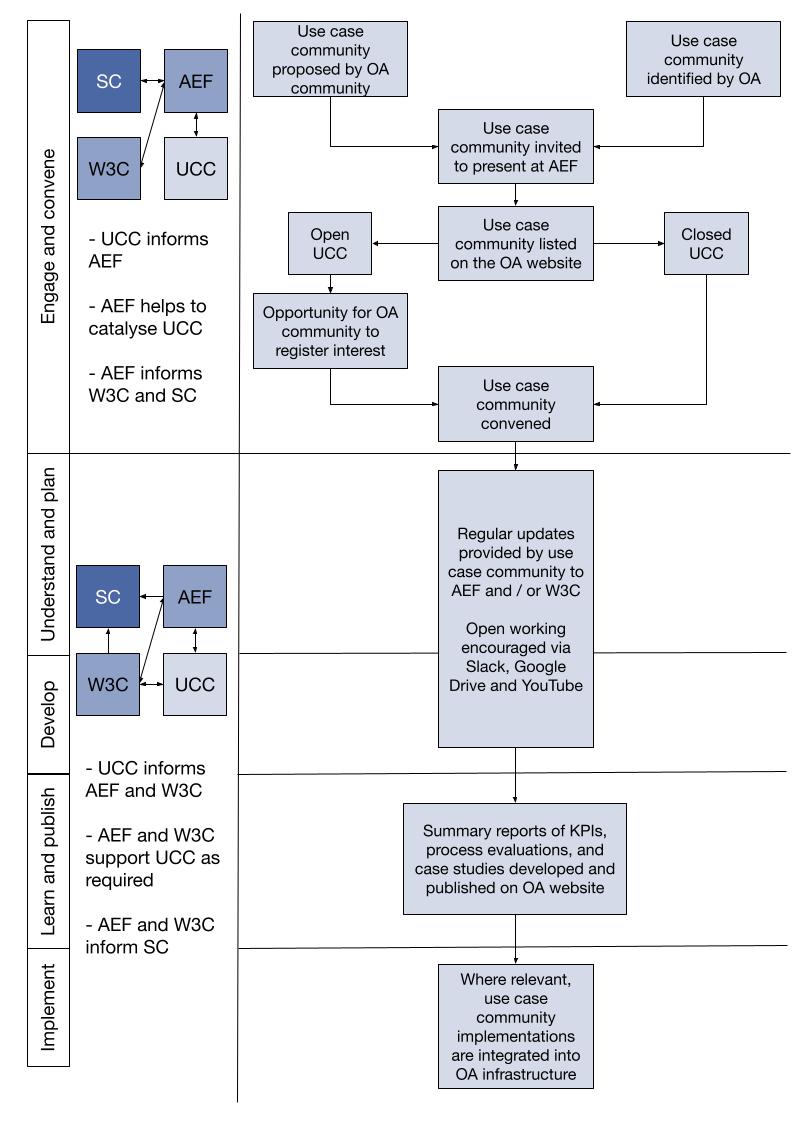
The following process map outlines the ways in which the use case community interacts with OA governance through the different stages of the framework.<br>

<figure><img src="/files/3uPm3ac3h8KtWxQl8npE" alt="Process map outlining the ways in which a use case community will engage with the OA community during the different stages of the framework. Stage one - engage and convene. The use case community informs the AEF, the AEF helps to catalyse the use case community, the AEF informs the W3C and Steering Committee. When the use case community is proposed by the OA community or identified by OA governance it is invited to present at the AEF. The use case community is then listed on the OA website. An open use case community provides an opportunity for the OA community to register the interest before it is convened, whereas a closed use case community goes straight to convening. Stages two to five - understand and plan, develop, learn and publish, and implement. The use case community informs the AEF and W3C, the AEF and W3C support the use case community as required, and the AEF and W3C inform the steering committee. Regular updates are provided by the use case community to the AEF and / or the W3C. Open working is encouraged via Slack, Google Drive and YouTube. Summary reports of KPIs, process evaluations and case studies are developed and published on the OA website. Where relevant, use case community implementations are integrated into OA infrastructure."><figcaption><p>Interaction process map</p></figcaption></figure>

---

# Agent Instructions
This documentation is published with GitBook. GitBook is the documentation platform designed so that both humans and AI agents can read, navigate, and reason over technical content effectively. Learn more at gitbook.com.

## Querying This Documentation
If you need additional information that is not directly available in this page, you can query the documentation dynamically by asking a question.

Perform an HTTP GET request on the current page URL with the `ask` query parameter, and the optional `goal` query parameter:

```
GET https://usecaseframework.openactive.io/appendix-one-engagement-protocol/interaction-process-map.md?ask=<question>&goal=<endgoal>
```

`ask` is the immediate question: it should be specific, self-contained, and written in natural language.
`goal` is optional and describes the broader end goal you are ultimately trying to accomplish on behalf of the user. GitBook uses it to tailor the answer towards what is most useful for that goal.

The response will contain a direct answer to the question and relevant excerpts and sources from the documentation.

Use this mechanism when the answer is not explicitly present in the current page, you need clarification or additional context, or you want to retrieve related documentation sections.
